Rome is redefining the relationship between urban mobility and cultural heritage, turning some of its metro stations into true underground exhibition spaces. Today, Line C stands as the most advanced testing ground for this vision: from the new stations at Colosseo–Fori Imperiali and Porta Metronia, to the station-museum at San Giovanni, which paved the way for a new way of moving through the city. These are places of transit that become places of knowledge, where waiting time is transformed into an immersive cultural experience. In a city built in layers, where every excavation is an encounter with history, the metro is no longer just a functional piece of infrastructure, but an ongoing narrative that accompanies residents and travellers into the very heart of the Capital.
- 1 Rome and the challenge of the metro: urban mobility and archaeological heritage
- 2 Station-museums: infrastructure that tells the story of the city
- 3 Porta Metronia: a station set against the Aurelian Walls
- 4 Colosseo–Fori Imperiali: a station at the symbolic heart of Rome
- 5 San Giovanni: the first major station-museum on Line C
- 6 Moving through and visiting station-museums as a new urban experience
- 7 Station-museums as part of Rome’s contemporary heritage
- 8 Reaching Rome by train: the journey begins with Italo
Rome and the challenge of the metro: urban mobility and archaeological heritage
A unique underground world: why building a metro in Rome is different
Building a metro in Rome means dealing with one of the most complex and stratified underground landscapes in the world. Every metre excavated brings traces of different eras to light: Roman roads, medieval buildings, Renaissance structures. Unlike many other European capitals, archaeology here is not the exception—it is the rule. This turns every infrastructure project into a technical, cultural and scientific challenge, where the priority is not just to move forward, but to understand, document and preserve.
Line C as a strategic infrastructure for the city
It is within this context that Line C takes shape, designed to connect the south-eastern and north-western areas of the city, easing surface traffic and improving the quality of everyday travel. Its arrival in the historic centre marks a crucial turning point: not only for mobility, but for the way Rome approaches modernity itself—by integrating innovation with its millennia-old past.
Numbers and development of Line C: stations, kilometres and urban connections
Today, Line C includes 24 stations along approximately 22 kilometres, running from the Monte Compatri/Pantano terminus to the heart of the city. A route that crosses suburban neighbourhoods and central districts, creating new connections and reshaping Rome’s urban geography. The new central stations represent the point of highest synthesis of this project: interchange hubs that are also gateways to the history of Rome.
Station-museums: infrastructure that tells the story of the city
What is meant by a “station-museum”
A station-museum is far more than a simple stop with information panels. It is a space designed to integrate archaeological finds into the everyday journey, making them an integral part of the travel experience. Display cases, curated installations, graphic elements and narrative pathways guide passengers along the way, turning transit into discovery.
The archaeological top-down method: building without interrupting history
To make all this possible, an innovative approach known as the archaeological top-down method was adopted—one developed specifically for Rome’s unique context. Excavation progresses from the top down, with floors built gradually to ensure structural stability, while archaeological investigations continue in parallel. This approach makes it possible to build and study at the same time, without compromising either safety or knowledge.
From function to storytelling: when waiting becomes a cultural experience
In these stations, waiting for a train is no longer “dead time”. It becomes a moment for observation, reading and reflection. Travellers are encouraged to slow down, notice details and understand how the city has evolved over the centuries. The metro thus turns into a diffuse and accessible museum, open every day and seamlessly woven into daily urban life.
What to see in Rome: the ultimate guide to must-see places
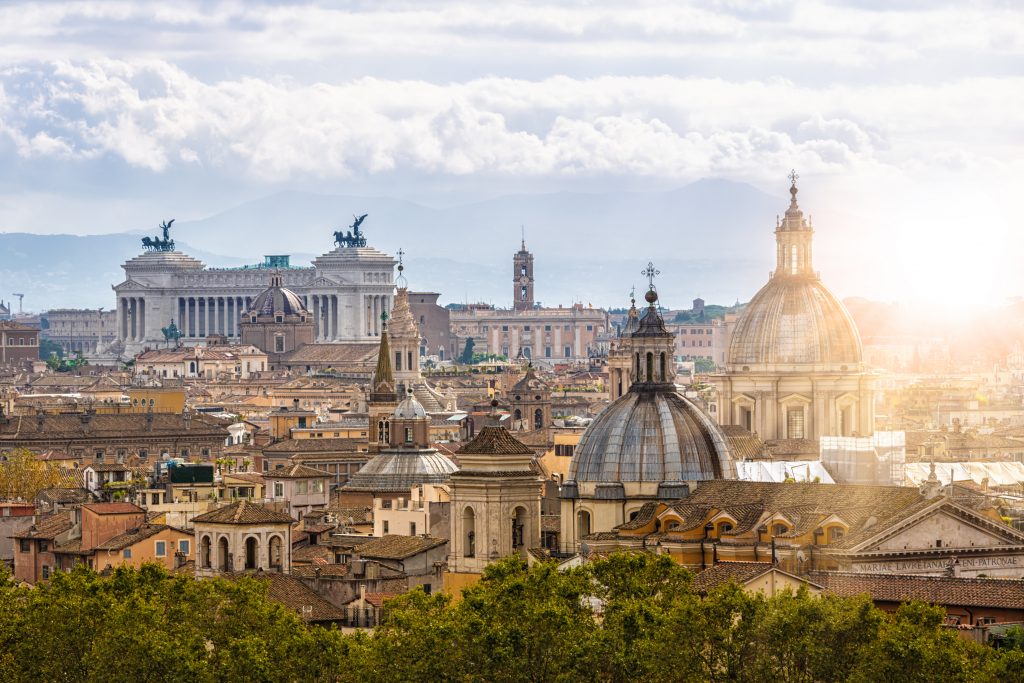
Rome is a city of grand emotions but also of small, intimate surprises: a sunset from the Janiculum Hill, a lantern-lit alley in Trastevere, a plate of carbonara served in a family-run trattoria.
Porta Metronia: a station set against the Aurelian Walls
Where it is and why it plays a key role on Line C
The Porta Metronia station is located in Piazzale Ipponio, right next to the Aurelian Walls. Its strategic position—between the historic centre and surrounding residential districts—makes it a crucial interchange point for urban mobility, as well as a place charged with strong symbolic value.
Depth, levels and architectural layout
Excavation works reached a depth of 30 metres, and the station unfolds across five underground levels. Two main entrances lead into spacious, light-filled areas, carefully designed to guide passenger flows in an intuitive and safe way, even within such a complex underground structure.
The museum atrium and the historical layers revealed during excavation
At the heart of the station lies a museum-style atrium, where graphic installations and interpretive panels tell the story of the archaeological discoveries and the area’s transformations over time. Ancient walls, structural remains and traces of everyday life emerge as chapters of a layered narrative, allowing travellers to grasp the depth and continuity of Rome’s urban history.
Porta Metronia as a new urban gateway between past and present
More than just a stop, Porta Metronia becomes an urban threshold—a place of passage that brings the ancient Rome of the walls into dialogue with the contemporary city. It is a clear example of how infrastructure and identity can coexist, turning mobility into an opportunity to connect different eras of the Capital.
Colosseo–Fori Imperiali: a station at the symbolic heart of Rome
Located along Via dei Fori Imperiali, between the Colosseum and the Basilica of Maxentius, this station rises in the most emblematic area of ancient Rome—a place that for centuries served as the political, religious and monumental centre of the Empire. Here, the metro enters into a direct dialogue with the city’s greatest landmarks, not merely skimming the surface, but intercepting history deep underground.
Archaeological excavations brought to light finds of extraordinary importance, mainly dating from a period spanning from the Republican era (2nd–1st century BC) to Late Antiquity (4th–5th century AD). Among the discoveries are monumental masonry structures, basalt and cocciopesto pavements, stretches of ancient roadways, drainage systems and remains of buildings connected to the monumental development of the Forum area. Some finds can also be linked to the major urban transformations of the Augustan age and subsequent emperors, when the Forums were enriched with new celebratory complexes and public spaces.
The station extends across four underground levels, with a width of up to 50 metres and a depth of over 30 metres—dimensions that reflect the complexity of a project carried out in one of the most archaeologically sensitive areas in the world. This very complexity made it possible to document the city’s successive layers, offering a vertical reading of Rome’s history: from the ancient city to Late Antiquity, and through to medieval and modern transformations of the urban fabric.
Inside, a true archaeo-station takes shape. A curated museum route accompanies travellers from the entrance down to the platforms. The artefacts are not displayed as they would be in a traditional museum; instead, they are integrated into the station’s architecture, through display cases, interpretive panels, graphic installations and exhibition solutions that connect the objects to the very place where they were discovered. The result is an immersive experience, where everyday travel becomes a journey through the centuries, moving through Republican, Imperial and Late Antique Rome.
The museum layout is curated and funded by the Parco archeologico del Colosseo, in collaboration with Sapienza Università di Roma – Department of Architecture and Design. This partnership brings together archaeological expertise, architectural design and public outreach, turning the Colosseo–Fori Imperiali station into an advanced model of integration between infrastructure, scientific research and cultural enhancement—one that tells the story of Rome not only as a city to visit, but as a city to be consciously experienced and crossed.
The connection with Line B and the central hub of the metro network
The direct interchange with Line B further strengthens the station’s role as a central node within the metro network, improving transport integration and making it easier to move between different areas of the city. A strategic connection that enhances both efficiency and accessibility in the very heart of Rome.
San Giovanni: the first major station-museum on Line C
The San Giovanni stop represents the first true station-museum built on Line C and one of the most successful examples of integration between contemporary infrastructure and stratified archaeological storytelling. Located at one of Rome’s most important urban junctions, close to the Basilica of San Giovanni in Laterano, this station paved the way for a new way of conceiving the metro in Rome—anticipating the model later developed at Colosseo–Fori Imperiali and Porta Metronia.
Excavations revealed archaeological evidence spanning an exceptionally wide time frame, from prehistory through to the medieval period, offering an almost uninterrupted sequence of tens of thousands of years of history. Among the most significant finds are prehistoric occupation levels, traces of agricultural activity from the Republican era, remains of Roman suburban settlements, hydraulic infrastructures, paving and materials linked to the gradual urbanisation of the area during the Imperial and Late Antique periods. Together, these discoveries tell the story of how what is now a densely built-up district was once a rural landscape, crossed by paths and cultivated land.
The station unfolds vertically, with a layout that becomes a narrative tool in its own right. As travellers descend towards the platforms, they move symbolically through the centuries: each level corresponds to a different historical phase, with chronological panels, displayed artefacts, maps and graphic installations explaining the evolution of the urban landscape. This is not a simple exhibition, but an integrated educational journey, designed to be clear and engaging even for visitors with no archaeological background.
San Giovanni is also a strategic interchange hub, thanks to its direct connection with Line A, and it clearly demonstrates how a high-traffic station can simultaneously become a space for everyday culture. Here, the function of transit blends seamlessly with interpretation and storytelling, transforming a place of passage into an accessible, free museum that is fully embedded in urban life.
With the San Giovanni station, Rome laid the foundations for a new paradigm: the metro not only as a way to move around the city, but as a tool to understand it. A model that Line C has since developed further, making station-museums one of the most innovative and distinctive features of contemporary Roman mobility.
3 days in Rome: the ultimate itinerary
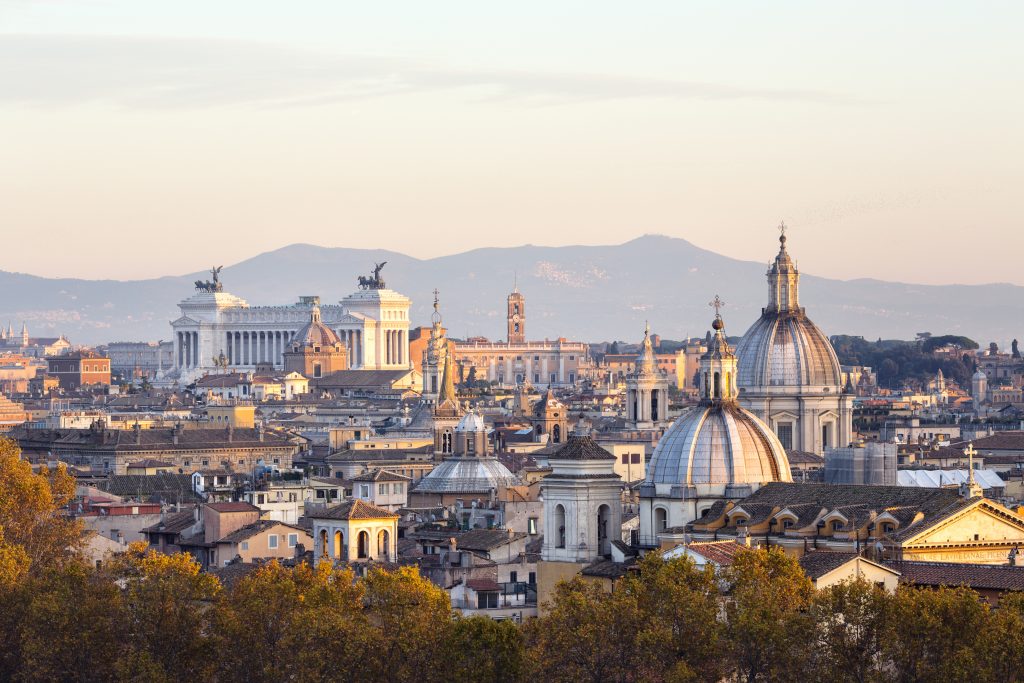
Maximize your Rome adventure in just 3 days with our essential guide. Explore iconic sights from the Colosseum to the Vatican, ensuring you experience the best of Italy’s eternal city.
Moving through and visiting station-museums as a new urban experience
Thanks to these stations, crossing Rome’s historic centre becomes easier and more sustainable. Travel times are reduced, while the journey itself gains depth and meaning, turning everyday movement into an integral part of the city visit.
Station-museums clearly show that sustainable mobility and cultural enhancement can move forward together. Reducing car use while simultaneously spreading knowledge is one of the most pressing challenges facing major historic cities today.
A model that can be replicated for the city’s future?
The Roman model has the potential to become an international benchmark. Integrating infrastructure with heritage is never simple, but the experience of Line C demonstrates that it is possible to innovate without erasing memory.
Station-museums as part of Rome’s contemporary heritage
These stations are not merely technical works, but places of everyday learning, accessible to everyone, without entrance fees and without cultural barriers.
Today, Line C stands as one of the most advanced examples of integration between public transport and urban culture—an open-air laboratory, or rather an underground one, shaping the future of the city.
With these station-museums, Rome opens a new chapter in its contemporary history: a city that keeps moving forward, without forgetting who it has been.
Reaching Rome by train: the journey begins with Italo
Choosing Italo to travel to Rome means starting the experience even before stepping off the train. Thanks to high-speed connections from major Italian cities such as Naples, Florence, Venice and Milan, you can arrive comfortably in the heart of the Capital, ready to move effortlessly between the historic centre, modern neighbourhoods and innovative infrastructures like the station-museums on Line C.
The train thus becomes the first step of a sustainable, efficient and culturally rich journey: once you arrive, Rome opens up immediately before your eyes, with its iconic monuments, its layers of archaeology and a metro network that tells the city’s story. With Italo, reaching Rome is not just about getting there, but about beginning a story worth experiencing.